Glossary of Climate Change Terms
Abrupt Climate Change Adaptation Adaptive Capacity Aerosols Afforestation Albedo Alternative Energy Annex I Countries/Parties Anthropogenic Atmosphere Atmospheric Lifetime B Biofuels Biogeochemical Cycle Biomass Biosphere Black Carbon Aerosol Borehole A
Sudden (on the order of decades), large changes in some major component of the climate system, with rapid, widespread effects.
Adjustment or preparation of natural or human systems to a new or changing environment which moderates harm or exploits beneficial opportunities.
The ability of a system to adjust to climate change (including climate variability and extremes) to moderate potential damages, to take advantage of opportunities, or to cope with the consequences.
Small particles or liquid droplets in the atmosphere that can absorb or reflect sunlight depending on their composition.
Planting of new forests on lands that historically have not contained forests. [1]
The amount of solar radiation reflected from an object or surface, often expressed as a percentage.
Energy derived from nontraditional sources (e.g., compressed natural gas, solar, hydroelectric, wind). [2]
Group of countries included in Annex I (as amended in 1998) to the United Nations Framework Convention on Climate Change, including all the developed countries in the Organization of Economic Co-operation and Development, and economies in transition. By default, the other countries are referred to as Non-Annex I countries. Under Articles 4.2 (a) and 4.2 (b) of the Convention, Annex I countries commit themselves specifically to the aim of returning individually or jointly to their 1990 levels of greenhouse gas emissions by the year 2000. [2]
Made by people or resulting from human activities. Usually used in the context of emissions that are produced as a result of human activities. [3]
The gaseous envelope surrounding the Earth. The dry atmosphere consists almost entirely of nitrogen (78.1% volume mixing ratio) and oxygen (20.9% volume mixing ratio), together with a number of trace gases, such as argon (0.93% volume mixing ratio), helium, radiatively active greenhouse gases such as carbon dioxide (0.035% volume mixing ratio), and ozone. In addition the atmosphere contains water vapor, whose amount is highly variable but typically 1% volume mixing ratio. The atmosphere also contains clouds and aerosols. [1]
Atmospheric lifetime is the average time that a molecule resides in the atmosphere before it is removed by chemical reaction or deposition. This can also be thought of as the time that it takes after the human-caused emission of a gas for the concentrations of that gas in the atmosphere to return to natural levels. Greenhouse gas lifetimes can range from a few years to a few thousand years.
Gas or liquid fuel made from plant material (biomass). Includes wood, wood waste, wood liquors, peat, railroad ties, wood sludge, spent sulfite liquors, agricultural waste, straw, tires, fish oils, tall oil, sludge waste, waste alcohol, municipal solid waste, landfill gases, other waste, and ethanol blended into motor gasoline. [4]
Movements through the Earth system of key chemical constituents essential to life, such as carbon, nitrogen, oxygen, and phosphorus. [3]
Materials that are biological in origin, including organic material (both living and dead) from above and below ground, for example, trees, crops, grasses, tree litter, roots, and animals and animal waste. [4]
The part of the Earth system comprising all ecosystems and living organisms, in the atmosphere, on land (terrestrial biosphere) or in the oceans (marine biosphere), including derived dead organic matter, such as litter, soil organic matter and oceanic detritus. [1]
Black carbon (BC) is the most strongly light-absorbing component of particulate matter (PM), and is formed by the incomplete combustion of fossil fuels, biofuels, and biomass. It is emitted directly into the atmosphere in the form of fine particles (PM2.5).
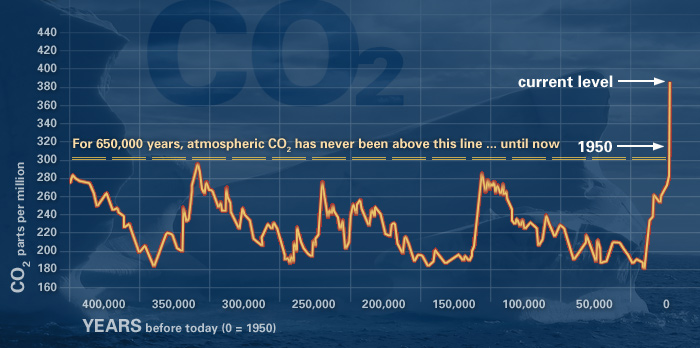
Any exploratory hole drilled into the Earth or ice to gather geophysical data. Climate researchers often take ice core samples, a type of borehole, to predict atmospheric composition in earlier years.