?Climate change: How do we know
The Earth's climate has changed throughout history. Just in the last 650,000 years there have been seven cycles of glacial advance and retreat, with the abrupt end of the last ice age about 7,000 years ago marking the beginning of the modern climate era — and of human civilization. Most of these climate changes are attributed to very small variations in Earth’s orbit that change the amount of solar energy our planet receives. The current warming trend is of particular significance because most of it is very likely human-induced and proceeding at a rate that is unprecedented in the past 1,300 years.1 Earth-orbiting satellites and other technological advances have enabled scientists to see the big picture, collecting many different types of information about our planet and its climate on a global scale. Studying these climate data collected over many years reveal the signals of a changing climate. Certain facts about Earth's climate are not in dispute: The evidence for rapid climate change is compelling: Sea level rise Global temperature rise Warming oceans Shrinking ice sheets Declining Arctic sea ice Glacial retreat Extreme events Ocean acidification This resource has been selected for inclusion in the CLEAN collection References B.D. Santer et.al., “A search for human influences on the thermal structure of the atmosphere,” Nature vol 382, 4 July 1996, 39-46 Gabriele C. Hegerl, “Detecting Greenhouse-Gas-Induced Climate Change with an Optimal Fingerprint Method,” Journal of Climate, v. 9, October 1996, 2281-2306 V. Ramaswamy et.al., “Anthropogenic and Natural Influences in the Evolution of Lower Stratospheric Cooling,” Science 311 (24 February 2006), 1138-1141 B.D. Santer et.al., “Contributions of Anthropogenic and Natural Forcing to Recent Tropopause Height Changes,” Science vol. 301 (25 July 2003), 479-483. 2 In the 1860s, physicist John Tyndall recognized the Earth's natural greenhouse effect and suggested that slight changes in the atmospheric composition could bring about climatic variations. In 1896, a seminal paper by Swedish scientist Svante Arrhenius first speculated that changes in the levels of carbon dioxide in the atmosphere could substantially alter the surface temperature through the greenhouse effect. 3 National Research Council (NRC), 2006. Surface Temperature Reconstructions For the Last 2,000 Years. National Academy Press, Washington, DC. 4 Church, J. A. and N.J. White (2006), A 20th century acceleration in global sea level rise, Geophysical Research Letters, 33, L01602, doi:10.1029/2005GL024826. The global sea level estimate described in this work can be downloaded 5http://www.ncdc.noaa.gov/oa/climate/research/ anomalies/index.html http://www.cru.uea.ac.uk/cru/data/temperature http://data.giss.nasa.gov/gistemp 6 T.C. Peterson et.al., "State of the Climate in 2008," Special Supplement to the Bulletin of the American Meteorological Society, v. 90, no. 8, August 2009, pp. S17-S18. 7 I. Allison et.al., The Copenhagen Diagnosis: Updating the World on the Latest Climate Science, UNSW Climate Change Research Center, Sydney, Australia, 2009, p. 11 http://www.giss.nasa.gov/research/news/20100121/ http://science.nasa.gov/headlines/y2009/ 01apr_deepsolarminimum.htm 8 Levitus, et al, "Global ocean heat content 1955–2008 in light of recently revealed instrumentation problems," Geophys. Res. Lett. 36, L07608 (2009). 9 L. Polyak, et.al., “History of Sea Ice in the Arctic,” in Past Climate Variability and Change in the Arctic and at High Latitudes, U.S. Geological Survey, Climate Change Science Program Synthesis and Assessment Product 1.2, January 2009, chapter 7 R. Kwok and D. A. Rothrock, “Decline in Arctic sea ice thickness from submarine and ICESAT records: 1958-2008,” Geophysical Research Letters, v. 36, paper no. L15501, 2009 http://nsidc.org/sotc/sea_ice.html 10 National Snow and Ice Data Center World Glacier Monitoring Service 11 http://lwf.ncdc.noaa.gov/extremes/cei.html 12 http://www.pmel.noaa.gov/co2/story/What+is+Ocean+Acidification%3F (Note: The pH of surface ocean waters has fallen by 0.1 pH units. Since the pH scale is logarithmic, this change represents approximately a 30 percent increase in acidity.) 13 http://www.pmel.noaa.gov/co2/story/Ocean+Acidification 14 C. L. Sabine et.al., “The Oceanic Sink for Anthropogenic CO2,” Science vol. 305 (16 July 2004), 367-371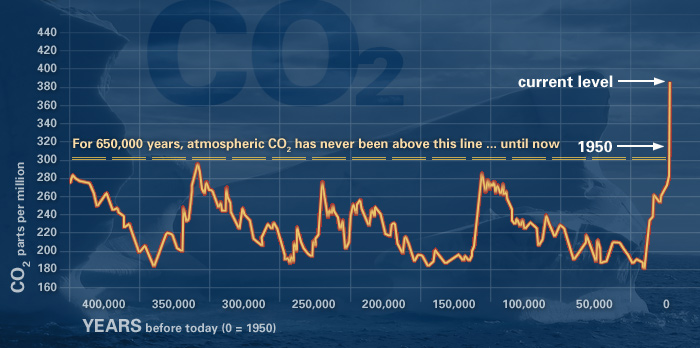
This graph, based on the comparison of atmospheric samples contained in ice cores and more recent direct measurements,
provides evidence that atmospheric CO2 has increased since the Industrial Revolution. (Source: NOAA)
"Scientific evidence for warming of the climate system is unequivocal." - Intergovernmental Panel on Climate Change 




1 IPCC Fourth Assessment Report, Summary for Policymakers, p. 5
from the CSIRO website.